
River Rock Estimator
River rock is heavy and sold by the ton, the cubic yard or the bag, so it pays to know exactly how much to order. Add your beds, pick a rock size and the estimator works out the depth, volume, weight and number of bags — with landscape fabric and edging to match.
- Free to use
- No sign-up
- Runs in your browser
River rock estimator
River Rock Project Pack
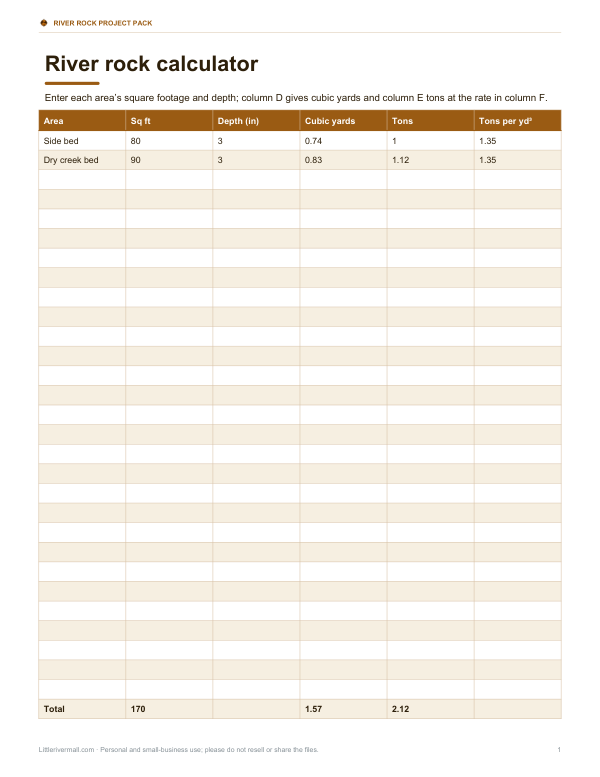
Excel river rock calculator for multiple areas, a printable rock size and coverage chart, a dry creek bed planning worksheet, a supplier quote comparison sheet and an installation checklist.
- Rock calculator (XLSX)
- Coverage chart (PDF/DOCX)
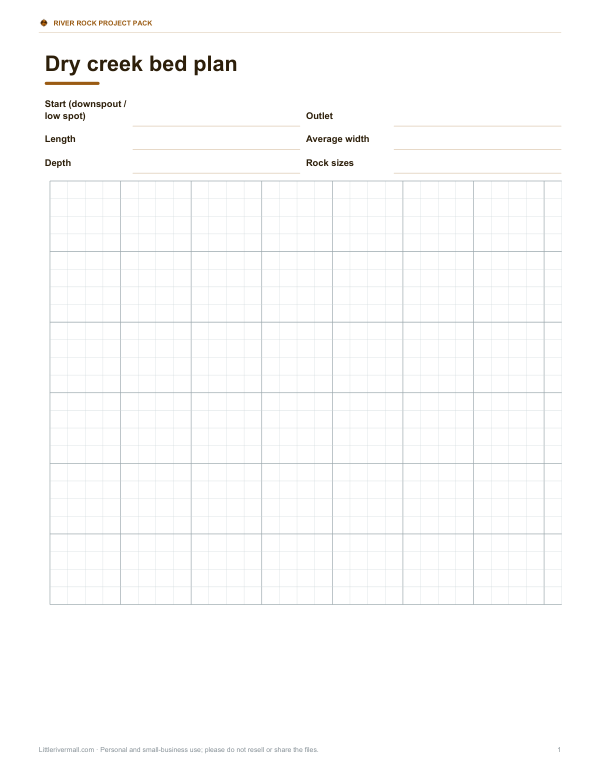
- Creek bed planner (PDF)
- Quote comparison (PDF/DOCX/XLSX)
- Install checklist (PDF/DOCX)
Formats: XLSX, PDF, DOCX. Instant download after payment (link valid 72 hours, up to 5 downloads). AI-assisted: the templates were drafted with AI help and reviewed and laid out before publishing.
$3.00 USD, one-time 5 files · about $0.60 each
- Instant download
- 7-day refund
- Secure checkout by Stripe
7-day money-back guarantee. Full refund within 7 days of purchase, even after you download.
Free sample: Dry Creek Planner (PDF, 95 KB)
Full refund within 7 days — see the refund policy and license.
Free printables
Single sheets you can print right now, no sign-up. The full pack adds every sheet in one download plus the editable files.
 Printable River Rock Quote Comparison
 Printable River Rock Installation Checklist
How the estimate works
- Area of each bed in square feet (length × width, π × radius², or ½ × base × height).
- Volume = area × depth in feet (depth in inches ÷ 12) → cubic feet; ÷ 27 → cubic yards.
- Weight = cubic yards × tons per cubic yard for your rock.
- Add 5–10% for uneven ground, settling and filling gaps.
River rock typically weighs roughly 1.3–1.5 tons per cubic yard depending on the stone and size; the 1.35 default is a middle value you should replace with your supplier’s figure.
Rock size and depth
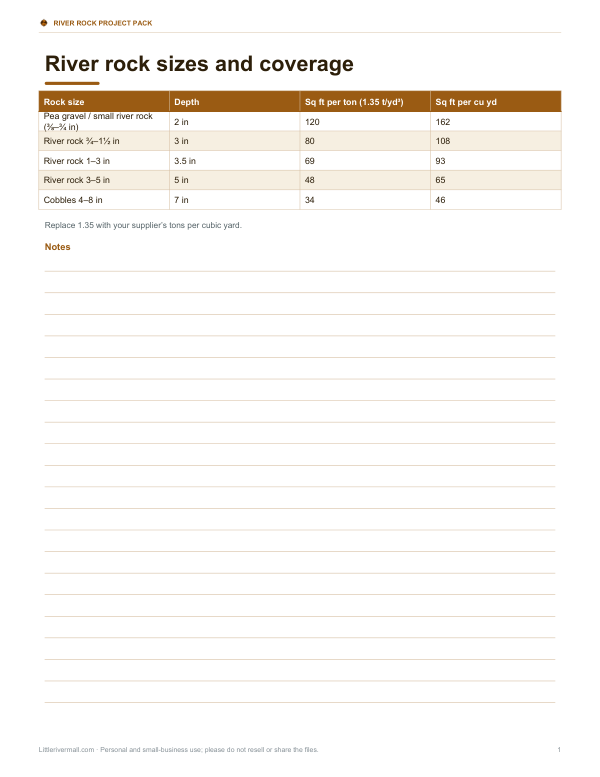
| Rock size | Suggested depth | Coverage of one ton (at 1.35 t/yd³) |
|---|---|---|
| Pea gravel / small river rock (⅜–¾ in) | 2 in | ≈ 120 sq ft |
| River rock ¾–1½ in | 3 in | ≈ 80 sq ft |
| River rock 1–3 in | 3.5 in | ≈ 69 sq ft |
| River rock 3–5 in | 5 in | ≈ 48 sq ft |
| Cobbles 4–8 in | 7 in | ≈ 34 sq ft |
A good rule is a depth of about twice the average stone size, so that the rocks overlap and hide the fabric underneath. Larger cobbles are usually laid one or two stones deep.
Worked example
A side bed 20 × 4 ft (80 sq ft), a 6 ft tree ring (28.3 sq ft) and a dry creek bed 30 ft long and 3 ft wide (90 sq ft) total 198.3 sq ft. With ¾–1½ in river rock at 3 in deep plus 10% extra, that is 2.02 cubic yards, or about 2.73 tons at 1.35 tons per yard — around 110 half-cubic-foot bags, which is why a bulk delivery makes sense.
Dry creek beds
A dry creek bed carries rainwater away from the house and looks natural when it varies in width and uses mixed sizes. Dig a shallow swale 6–12 inches deep with sloping sides, line it with landscape fabric that runs up the sides, place larger cobbles and boulders along the edges and in bends, then fill the channel with smaller river rock. The estimator adds extra fabric for the sloped sides of creek-bed areas.
Bulk vs bagged river rock
| Bulk (by ton or yard) | Bagged (0.5 cu ft) | |
|---|---|---|
| Best for | Projects over about half a ton | Small beds, pots and top-ups |
| Handling | Delivered in a pile; move with wheelbarrow | Carry bag by bag |
| Cost | Usually lower per ton, plus delivery | Higher per ton, no delivery fee |
| Choice | Wide range of local stone | A few standard colours and sizes |
| Leftovers | Hard to return | Easy to buy exactly what you need |
Ask bulk suppliers whether they sell by weight or by volume, their minimum order and delivery fee, and whether the truck can dump where you need it without damaging a driveway or lawn.
Choosing river rock colour and size
River rock ranges from grey and white to tan, pink and mixed “rainbow” stone, depending on where it’s quarried. Small, smooth rock is comfortable underfoot for paths and fills gaps well; mid-size rock suits garden beds and around downspouts; large cobbles make edges and creek-bed banks. Wet the stone to see its colour when it rains — many river rocks look much richer wet. Buy all your rock in one order so the colour and size match.
Converting between tons, yards and bags
| Quantity | Cubic feet | Bags (0.5 cu ft) | Tons at 1.35 t/yd³ |
|---|---|---|---|
| 1 cubic yard | 27 | 54 | 1.35 |
| 1 ton | 20 | 40 | 1 |
| ½ cubic yard | 13.5 | 27 | 0.68 |
| 10 bags | 5 | 10 | 0.25 |
These conversions use the default weight; change it in the estimator for your supplier’s stone.
Maintenance
Rake the rock to redistribute it, blow or rake out leaves before they break down into soil, and pull weeds while they are small. Every few years, top up thin areas. In hot sunny spots, dark or large rock beds heat up and can stress nearby plants — leave a mulched ring around shrubs and trees.
Installation tips
- Remove weeds and grass, and level or slope the ground for drainage.
- Lay a woven landscape fabric, overlapping seams by 6–12 inches, and pin it down.
- Install edging first to keep rock out of the lawn.
- Spread rock with a rake and top up low spots after a few weeks of settling.
- Wear gloves and lift with your legs — a cubic yard can weigh well over a ton.
- Check local rules before placing rock over utilities or in drainage ways.
Privacy
All calculations run in your browser.
Frequently asked questions
How much does a ton of river rock cover?
About 80 sq ft at 3 inches deep or 120 sq ft at 2 inches, at 1.35 tons per yard.
How deep should river rock be?
About twice the average stone size — 2–3 inches for small rock, 4–6 for larger.
How many bags make a cubic yard?
54 half-cubic-foot bags.
Do I need landscape fabric?
It’s recommended to stop weeds and keep rock from sinking into soil.
Is bulk or bagged cheaper?
Bulk is usually cheaper per ton for larger jobs; bags suit small areas.
How heavy is river rock?
Roughly 1.3–1.5 tons per cubic yard; ask your supplier.
Can I put river rock around plants?
Yes, but keep it a few inches from stems and trunks and consider mulch in hot, sunny beds.
How many tons are in a cubic yard?
Roughly 1.3–1.5 for river rock, depending on size and stone type.